
Overview
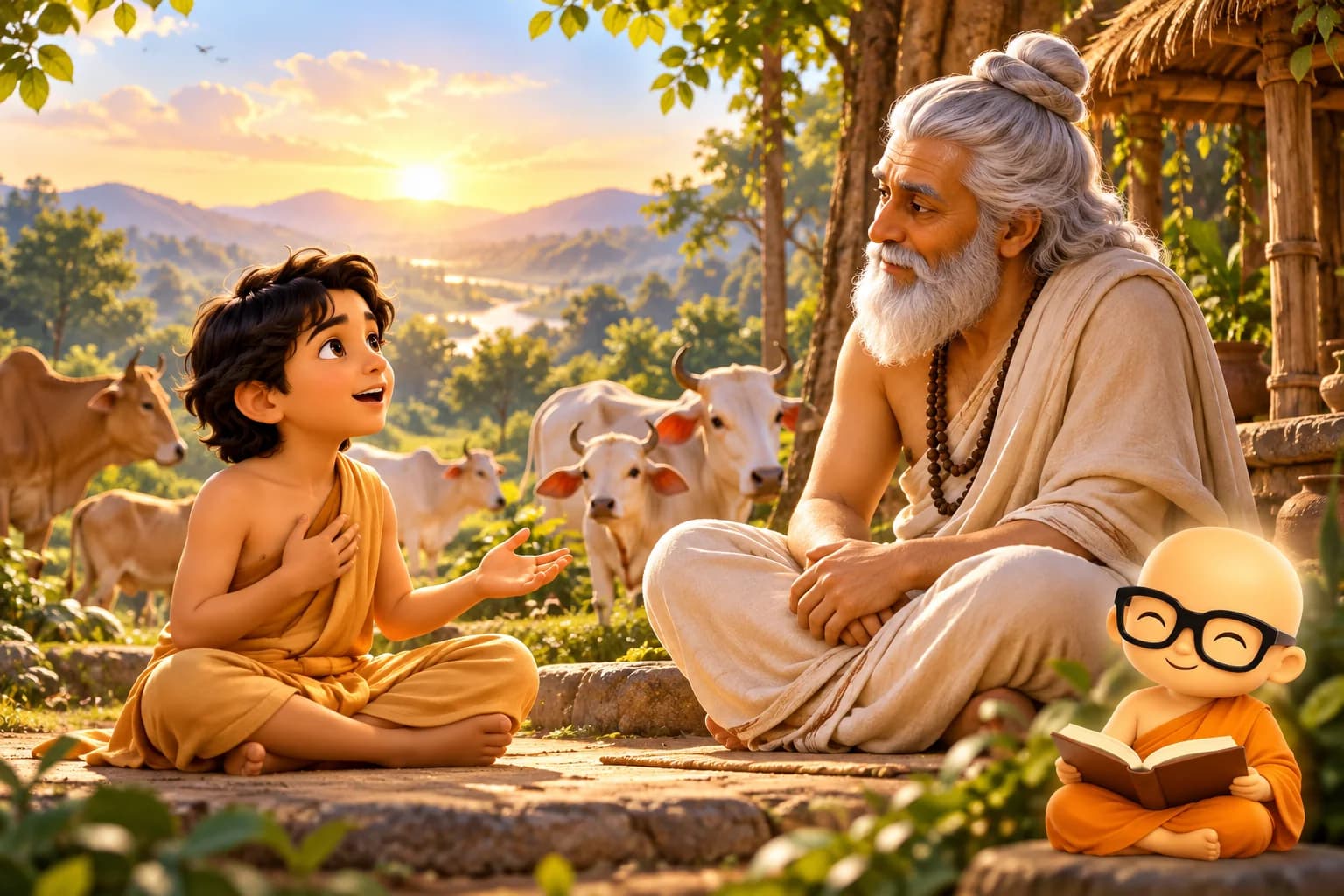
Satyakama seeks a teacher and admits he does not know his father’s lineage. His mother tells the truth; Gautama recognizes the young seeker’s honesty and accepts him.
The story
Satyakāma wanted to study with Hāridrumata Gautama. Before accepting him, the teacher asked his gotra, or family lineage. Satyakāma did not know, so he asked his mother Jābālā. She answered honestly: when she had been young and moving among many households, she had served in different places and did not know who his father was. She told him to say exactly that and give his name as Satyakāma Jābāla.
He returned and repeated her words without embellishment. Gautama replied that only a person of true integrity could speak so plainly and accepted him as a student. He gave Satyakāma four hundred lean cattle and asked him to return when they had grown to a thousand. Satyakāma went into the forest and cared for them over many years. The long tending is part of his education: he keeps faith with his teacher’s instruction and learns through attentive life, not only from a lecture.
When the herd reached a thousand, a bull spoke to him about one quarter of Brahman, associated with the directions and the vast world. Later the sacred fire, a swan, and a diving bird each taught him another quarter—through images of the earth and heavens, light, and life-breath. These are symbolic teachings, not ordinary conversations with animals. Satyakāma brought the herd back to Gautama. The teacher saw that he had gained a radiance through learning, but completed the instruction, affirming that knowledge received from a teacher is made whole by a teacher.
The Upaniṣad honours both Jābālā’s candour and her son’s truthfulness. It also presents learning as a relationship between honesty, patient practice, the natural world, and a teacher’s guidance.
The four teachings are presented as four “quarters” of Brahman, not as a complete lesson given by the animals alone. The bull points to the directions and their vastness; the fire names the earth, atmosphere, heaven, and ocean; the swan speaks of fire, sun, moon, and lightning; the diving bird turns attention to breath, sight, hearing, and mind. Each offers a portion of the teaching, and Gautama supplies what completes it. Satyakāma returns not with a boast but with the herd he was entrusted to care for. The narrative gives equal weight to truthful speech, years of patient service, and learning from a qualified teacher.
Understanding the story
Jābālā’s candour matters as much as Satyakama’s: she gives him the truth she has, and he does not invent a pedigree. The Upanishad places integrity at the entrance to learning.
In everyday life
Say what you know and name what you do not know. In study and work, honest limits build trust and make it possible to learn without pretending or falsifying credentials.
In today’s world
The episode speaks to fair access to education and hiring. It encourages mentors to look for character and curiosity, while institutions should avoid letting inherited status decide who gets to learn.
Traditional source
Chāndogya Upaniṣad 4.4–4.9: Jābālā and Gautama’s acceptance, Satyakama’s life with the herd, the teachings he receives, and his return to his teacher.
Topics: Wisdom · Learning · Truth · Satyakama · Upanishad
← All stories