
Overview
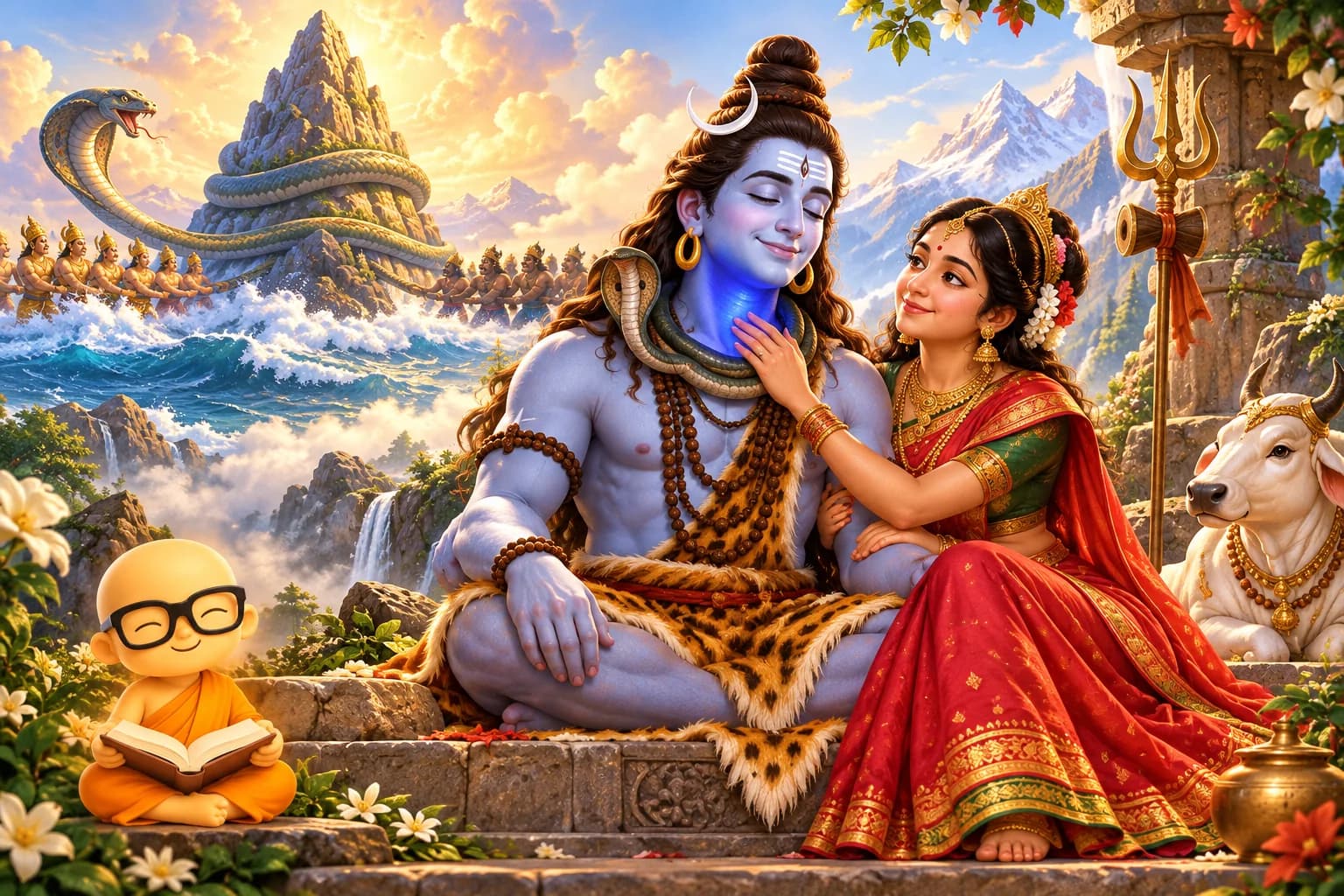
During the churning of the cosmic ocean, deadly poison emerges before the nectar of immortality. Lord Shiva consumes the poison to protect all living beings, revealing the true nature of selfless leadership.
The story
When the Devas lost their heavenly splendour and vigour through Sage Durvasa's curse, the Asuras gained supremacy over the cosmos. Seeking a way to restore their vitality, the gods turned to Lord Vishnu. Vishnu advised them to forge a temporary truce with the Asuras to churn the cosmic Ocean of Milk (Kshira Sagara). Hidden beneath the waves were treasures of boundless wonder, along with the divine Amrita—the nectar of immortality.
The cosmic endeavor required immense cooperation. Mount Mandara was uprooted to serve as the churning rod, and the gigantic serpent Vasuki agreed to serve as the churning rope. Lord Vishnu took the form of the great turtle Kurma to dive to the bottom of the ocean and support the sinking mountain upon his steadfast shell. With Devas holding the tail and Asuras holding the head, the ocean was churned with ferocious intensity.
Yet before any celestial treasures appeared, the ocean churned up a terrifying darkness: Halahala (Kalakuta), an all-consuming cosmic poison whose fumes began suffocating the three worlds. Neither gods nor demons had the power to withstand it. In sheer desperation, they fled to Mount Kailash and prayed to Lord Shiva, the eternal ascetic, begging for protection.
Moved by boundless compassion for all created beings, Lord Shiva gathered the burning poison into his palm and drank it as if it were sweet water. Seeing the venom descend toward his throat, Goddess Parvati placed her hand upon his neck, stopping it there so it would not harm his body or the universe dwelling within him. The virulent poison stained Shiva's throat dark blue, earning him the revered name Neelakantha—the Blue-Throated One.
Only after the peril had been absorbed did the ocean yield its miraculous boons: Kamadhenu the wishing cow, Airavata the white elephant, the celestial Parijata tree, Goddess Lakshmi bearing lotus blossoms of prosperity, and finally Dhanvantari carrying the pot of Amrita. The story endures as a profound reminder that before the nectar of any great collective endeavor is realized, poison and hardship inevitably arise first.
Understanding the story
Leadership and spiritual maturity are tested not when dividing rewards, but when danger appears. Shiva exemplifies the ideal of absorbing collective toxicity with grace, asking for nothing in return.
In everyday life
When facing difficult group projects or family challenges, expect turbulence before success. Do not push blame or toxic reactions onto others; respond with calm emotional regulation and constructive action.
In today’s world
Modern leadership often focuses on claiming victory, but ethical leadership is measured by who shields the team during a crisis. Shiva models selfless courage by containing harm rather than passing it down.
Traditional source
Srimad Bhagavata Purana, Skandha 8, chapters 6–8; Vishnu Purana, Book 1, chapter 9; Mahabharata, Adi Parva, Astika Parva.
Topics: Leadership · Sacrifice · Compassion · Shiva · Puranas · Samudra Manthan
← All stories