
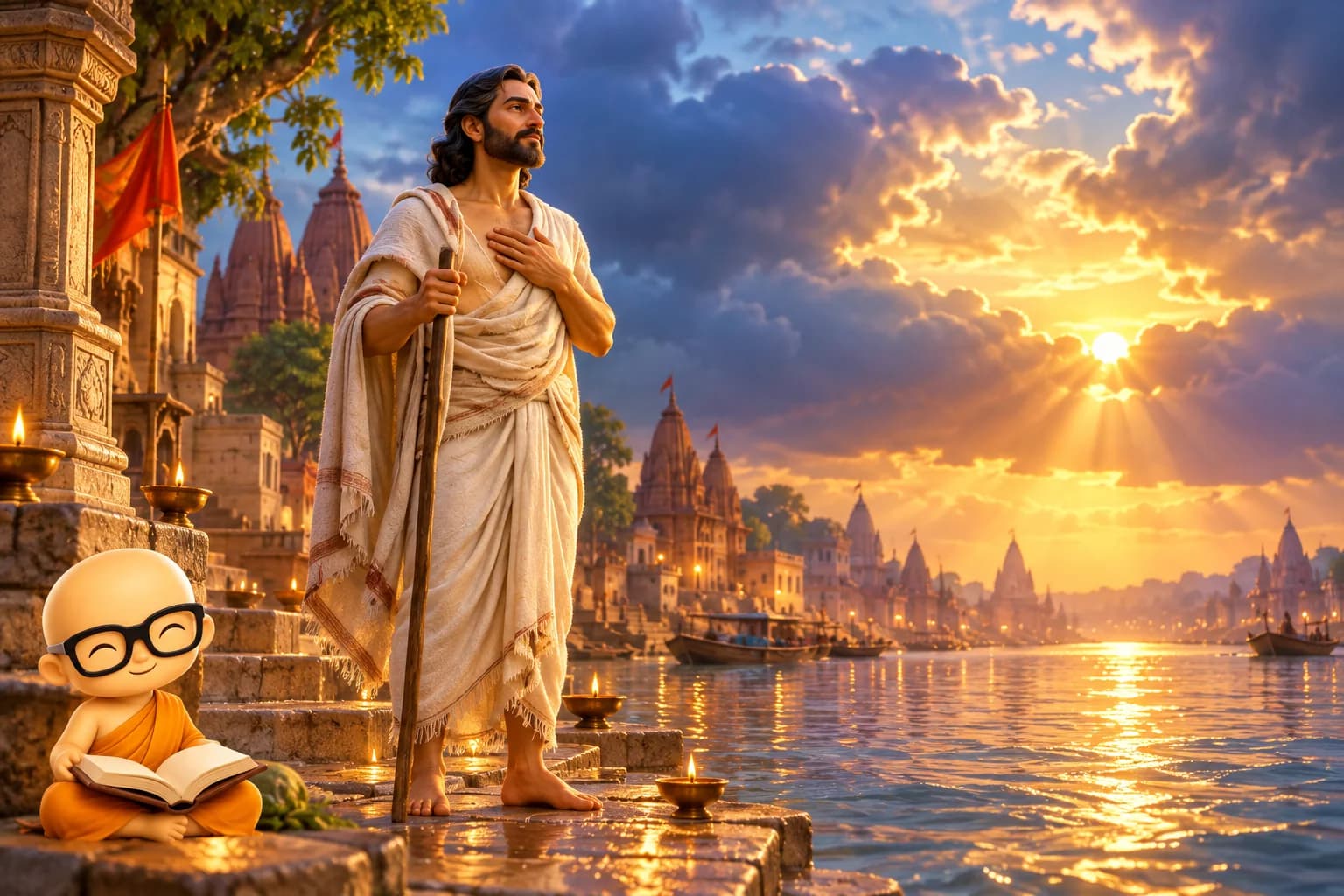
Overview
King Harishchandra loses his throne, kingdom, and family, serving as a cremation ground worker rather than breaking a single promise. His endurance establishes Satya (Truth) as the unshakeable foundation of dharma.
The story
King Harishchandra of Ayodhya, an ancestor of Lord Rama in the legendary Solar dynasty (Suryavansha), was celebrated across the realms as an exemplar of righteousness who had never uttered an untruth or broken a promise. In the celestial assembly of Indra, Sage Vasishtha declared that Harishchandra’s commitment to truth was absolute. Sage Vishwamitra questioned whether any mortal’s honesty could withstand absolute ruin, and set out to test the king’s conviction.
Vishwamitra approached Harishchandra and requested his entire kingdom as an offering. Without a moment's hesitation, Harishchandra stepped down from his golden throne and surrendered his palace, treasury, and armies. When the sage demanded the customary monetary dakshina to seal the gift, Harishchandra promised to pay it within a month. Stripped of all possessions, the king walked out of Ayodhya dressed in bark garments, accompanied only by his loyal queen Taramati and young son Rohitashva.
Arriving in the sacred city of Varanasi with the deadline pressing, Harishchandra had no coins left. To fulfil his solemn debt, he first sold his beloved queen and young son into domestic servitude. When that proved insufficient, he sold himself into bondage to a keeper of the burning ghats (cremation grounds). Harishchandra spent days and nights amidst smoke and ashes, tasked with collecting the burial tax for every corpse brought to the pyres.
The ultimate trial arrived on a stormy night when Rohitashva died from a snakebite in a forest garden. Distraught and penniless, Queen Taramati carried the cold body of their only child to the cremation ground in the dead of night. Though Harishchandra recognized his grieving wife and dead son, his duty to his master was clear: no body could be cremated without payment of the customary tax. Taramati tore a piece from her solitary remaining cloth to pay the fee. As they prepared the pyre with broken hearts, Vishwamitra and the celestial devas appeared in radiant glory. The ordeal had ended; Rohitashva was restored to life, and Harishchandra’s unwavering commitment to Satya became an eternal beacon for humanity.
Understanding the story
Truth (Satya) is not a casual convenience; its real test occurs when honesty costs everything one holds dear. Harishchandra’s unwavering vow proves that integrity survives the loss of worldly fortune.
In everyday life
Uphold your ethics and keep your promises even when circumstances turn difficult. A reputation built on dependable honesty is more valuable than temporary material advantage.
In today’s world
In professional ethics, governance, and public life where cutting corners and deception are often normalized, Harishchandra proves that a person's word and honor are their only true wealth.
Traditional source
Markandeya Purana, chapters 7–8; Devi Bhagavata Purana, Skandha 6; Mahabharata, Sabha Parva.
Topics: Courage · Truth · Puranas · Integrity · Harishchandra · Satya
← All stories