
Overview
Prahlada keeps his devotion to Vishnu despite his father Hiranyakashipu’s threats. Narasimha’s appearance ends the king’s tyranny and reveals the limits of power built on fear.
The story
Hiranyakashipu’s brother had been killed by Vishnu, and the asura king made vengeance his purpose. After severe austerities he won boons that seemed to place him beyond death: he should not die by man or beast, indoors or outdoors, by day or night, on earth or in the sky, or by a weapon. He returned to rule the three worlds and demanded worship. His young son Prahlada, however, spoke of Vishnu as the one worthy of devotion.
Hiranyakashipu sent Prahlada to teachers Shanda and Amarka, who taught the sons of the asuras. The child learned their lessons but also taught his classmates to remember Hari and turn toward a life of virtue. His father questioned him about the source of this teaching. Prahlada said that the Lord could be found everywhere. The king’s anger grew. The Purāṇa recounts attempts to kill the boy—through weapons, elephants, snakes, poison, fire, and a fall from a height. Prahlada survives each ordeal; the point is the king’s escalating violence and the boy’s unwavering devotion, not a command to seek suffering.
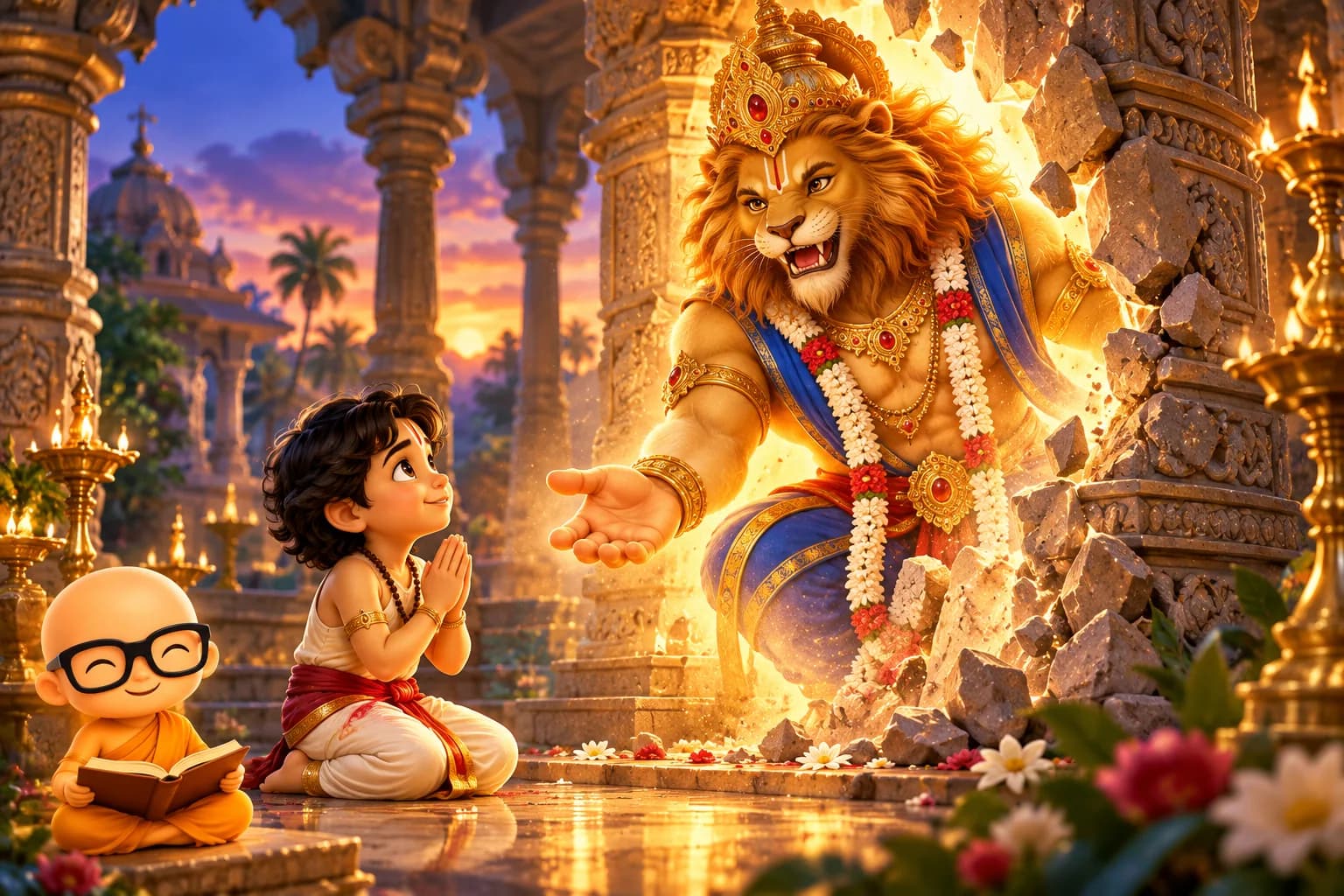
At last Hiranyakashipu struck a pillar and demanded to know whether Vishnu was in it. Narasimha emerged: neither fully man nor beast. At twilight, on a threshold, he placed the king on his lap and killed him with his claws—not with a weapon, not indoors or outside, and not on earth or in the sky. The form and moment answer the protections Hiranyakashipu had demanded.
The gods were afraid to approach Narasimha in his fury. Prahlada went forward and prayed. He asked not for revenge or riches but for compassion, even for his father. The episode ends by setting a child’s humility against a ruler’s pride and by making protection, not domination, the mark of divine power.
After Hiranyakashipu fell, Prahlada did not approach the furious Narasimha at once; even the gods held back. At Brahmā’s request the child came forward, offered prayers, and asked for no private reward. Narasimha invited him to choose a boon. Prahlada asked that his father’s wrongs be forgiven and that he himself never become attached to power or pleasure. The Lord placed him on the throne to govern. The ending does not make the violence disappear; it shows the child who endured it becoming a ruler defined by humility rather than fear.
Understanding the story
Prahlada’s faith is joined to compassion; he does not answer cruelty with hatred. The story names Hiranyakashipu’s violence as wrongdoing, so devotion should never be used to pressure someone to remain in danger.
In everyday life
Hold to your values under pressure, while seeking trusted support and safety when someone abuses power. Compassion does not require accepting harm or giving an oppressor access to you.
In today’s world
The episode speaks to coercive leadership, bullying, and freedom of conscience. In workplaces, families, and communities, authority is strongest when it protects people instead of demanding unquestioning praise.
Traditional source
Śrīmad Bhāgavata Purāṇa, Skandha 7, especially chapters 4–10; Prahlada’s confrontation with Hiranyakashipu and Narasimha’s appearance are chiefly in chapters 8–9. Details vary among traditions.
Topics: Courage · Devotion · Prahlada · Narasimha · Bhagavata Purana
← All stories