
Overview
Nachiketa questions a hollow ritual, travels to Yama, and uses his three boons to ask what remains after death. He chooses enduring knowledge over wealth and pleasure.
The story
Vājaśravasa performed a sacrifice in which he gave away his possessions. His young son Nachiketa watched the gifts being led away and saw that some of the cows were old, barren, and unable to give milk or calves. Concerned that the offering was hollow, he asked his father, “To whom will you give me?” He asked more than once. Irritated, Vājaśravasa answered, “I give you to Death.” Nachiketa took his father’s words seriously and went to Yama’s house.
Yama was absent. Nachiketa waited three nights without food or hospitality. When Yama returned, he apologized for neglecting a guest and offered three boons. First Nachiketa asked that his father’s anger pass and that he welcome his son home. Second, he asked to learn the fire-sacrifice that leads to heaven; Yama taught him the rite and it became known by Nachiketa’s name.
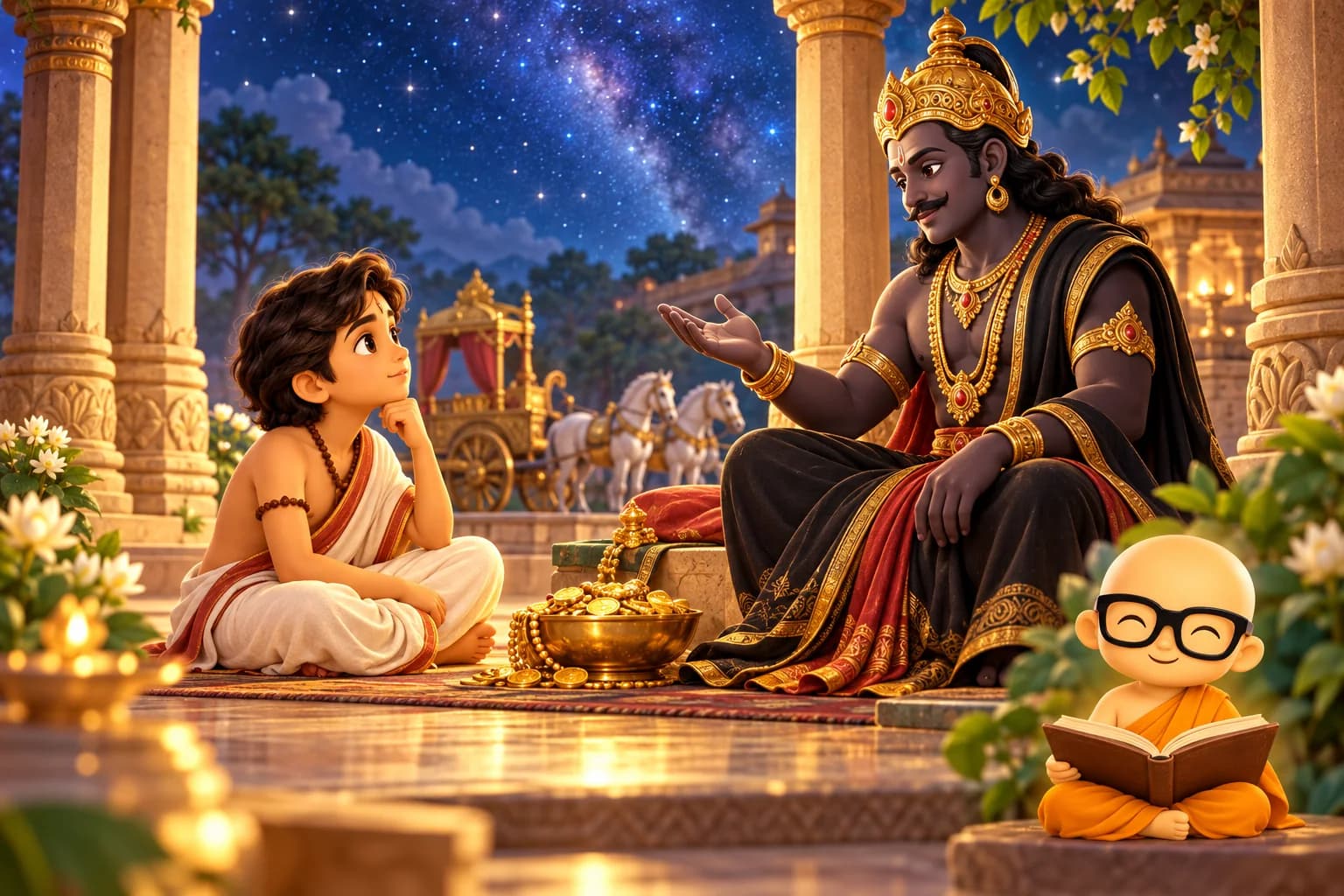
For his third boon, Nachiketa asked what happens after death. Some say a person continues to exist; others say nothing remains. “Teach me the truth,” he asked. Yama offered long life, wealth, music, chariots, and every pleasure instead. Nachiketa understood that these gifts would wear away and could not answer his question. He chose knowledge of the Self over what merely pleases for a moment.
Yama taught him to distinguish śreyas, the truly good, from preyas, the immediately pleasant. He described the body as a chariot, the senses as horses, the mind as reins, and the discerning self as the charioteer: without discipline, the journey wanders; with understanding, it reaches its goal. The dialogue then turns to the imperishable Self, which is not grasped by wealth or by the senses. The Katha Upaniṣad makes Nachiketa’s questioning a philosophical inquiry into how to live and what, if anything, death can take away.
The first boon returns the story to its beginning: Nachiketa wants reconciliation with his father, not escape from him. The second shows that he is willing to learn a ritual teaching carefully, not only ask abstract questions. But for the third he refuses to be distracted. Yama’s chariot, music, wealth, and long life are not called evil; they simply cannot answer what happens beyond death. Nachiketa asks Yama to keep those gifts for himself.
The chariot image gives the teaching a practical shape: senses need guidance, the mind must hold the reins, and discernment must choose the road. The Upaniṣad then insists that the Self is subtler than what the eyes see and does not perish with the body. Yama’s answer is a sustained philosophical dialogue, and different Hindu schools explain its account of the Self in different ways. Nachiketa’s story closes as both a moral choice and a serious invitation to inquire.
Understanding the story
Nachiketa distinguishes the pleasant from the worthwhile. His courage is intellectual: he keeps asking a serious question when easy rewards are offered instead.
In everyday life
Before choosing, ask whether an attractive short-term reward serves your deeper values. In uncertain moments, make room for difficult questions rather than rushing toward the easiest answer.
In today’s world
The story offers a counterweight to constant consumption and distraction. It invites reflection on attention, mortality, and what makes a life meaningful—without prescribing one answer for every reader.
Traditional source
Kaṭha Upaniṣad, Adhyāya 1, Vallīs 1–3 and Adhyāya 2, Vallīs 1–3 (section numbering varies by edition).
Topics: Wisdom · Yama · Upanishad · Nachiketa · Self-knowledge
← All stories