
Overview
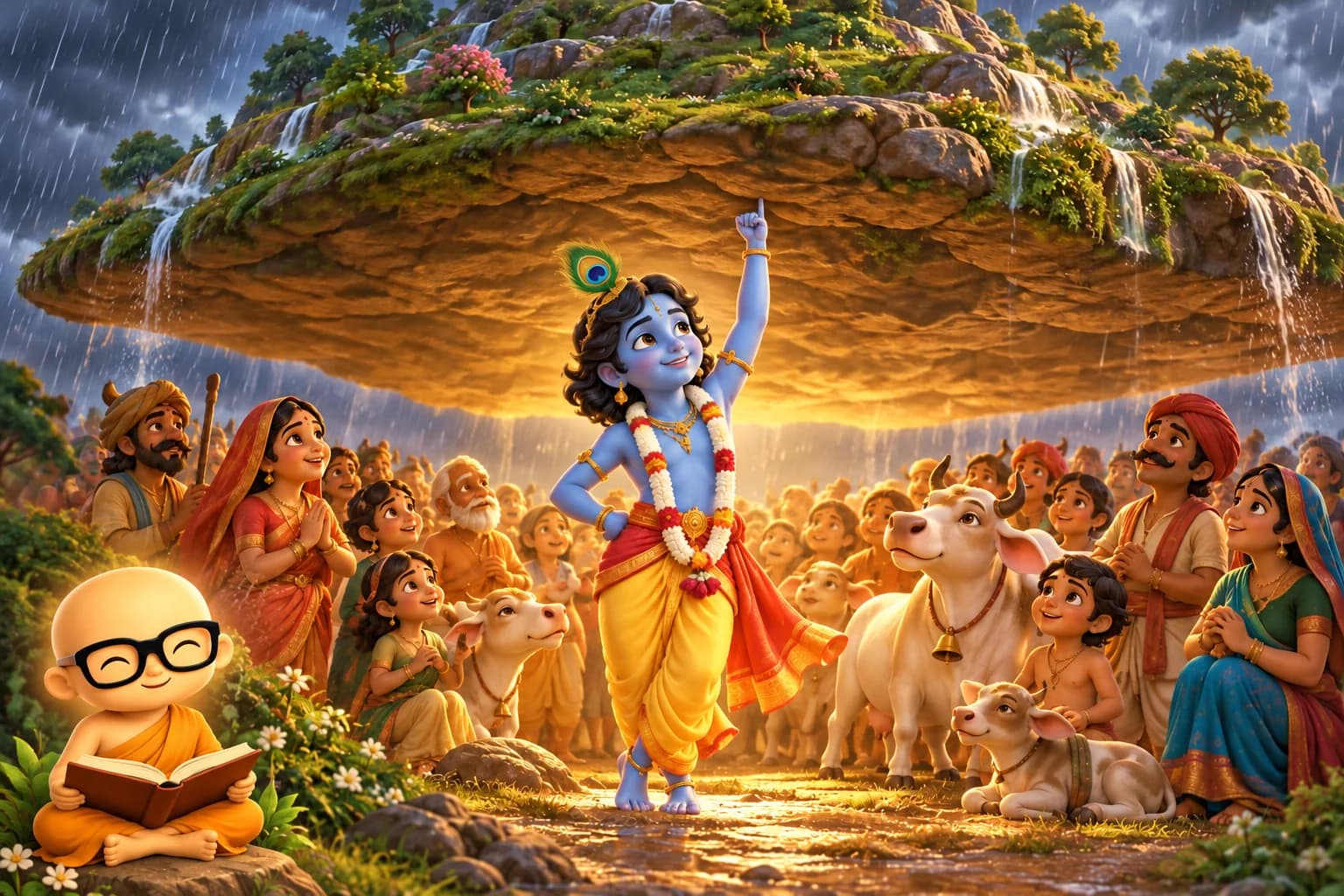
Krishna shelters Vraja beneath Govardhana Hill when Indra sends a destructive storm. The episode celebrates protection and community while challenging prideful authority.
The story
As the people of Vraja prepared their customary offering to Indra, Krishna asked his father Nanda what the rite was for. The cowherds explained that Indra sent the rain on which their lives depended. Krishna asked them to look closely at the work and landscape sustaining them: Govardhana Hill, its grasses and streams, their cattle, and the labour of the community. He persuaded them to honour Govardhana and the cows with the food they had prepared. The people circumambulated the hill and shared the offerings.
Indra took the change as an insult and sent the Samvartaka clouds to flood Vraja with rain, wind, and hail. The cowherds and cattle shivered and ran to Krishna for shelter. He lifted Govardhana on his little finger and called everyone beneath it. For seven days the community stayed together under the hill. Krishna held it steady while the people cared for children, elders, and animals. When the storm finally stopped, Krishna set the hill down and the people returned safely to their homes.
Indra recognized that pride had turned his authority into harm. He came with Surabhi, the celestial cow, offered praise, and performed an abhiṣeka of Krishna, who was honoured as Govinda, protector of cows and the people of Vraja. The episode ends not with Indra destroyed, but with his pride corrected and the community restored.
For devotees, Govardhana is a sacred form of Krishna. The narrative also draws attention to shared shelter and the land that sustains a community—an ecological reflection inspired by the story, rather than a modern policy stated in the Purāṇa.
The shelter was practical as well as miraculous. The frightened people did not scatter into the storm: families, elders, and cattle gathered in one place. The text describes Krishna holding the hill effortlessly while reassuring the cowherds; no one is asked to prove devotion by standing in the rain. After the seven days, Indra’s approach to Krishna is a confession that a ruler’s pride can make power destructive. Surabhi’s abhiṣeka names Krishna Govinda. In temple and village traditions, Govardhana-pūjā still recalls the hill, the cows, and the shared offering at the center of this story.
Understanding the story
The hill becomes shared shelter: people and animals survive by gathering and caring for one another. Indra’s power is corrected by humility; the story also honours the land that sustains the community.
In everyday life
In a crisis, organize shared protection, include those most exposed, and recognize the natural resources on which daily life depends. Leaders should listen and correct course when pride harms others.
In today’s world
The narrative invites reflection on disaster preparedness, community resilience, and care for local ecosystems. These are present-day applications inspired by the episode, not modern policies stated in the Purana.
Traditional source
Śrīmad Bhāgavata Purāṇa, Skandha 10, chapters 24–27, especially chapter 25 for the storm and 26 for Indra’s acknowledgement.
Topics: Protection · Krishna · Bhagavata Purana · Govardhana · Indra
← All stories