
Overview
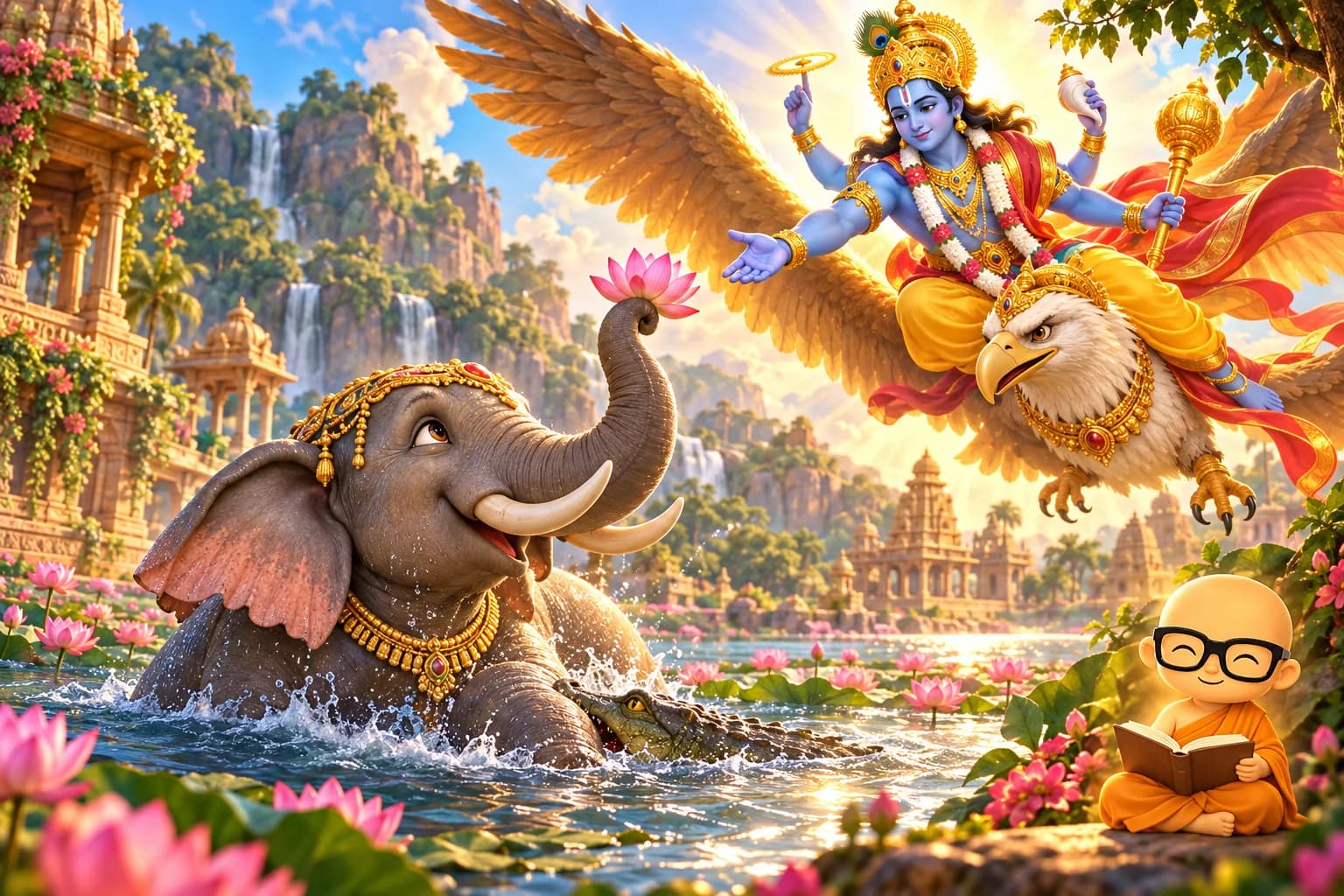
Gajendra, an elephant king, cannot free himself from a crocodile’s grip. At the limit of his strength, he prays and is rescued by Vishnu; the Purana frames the episode as liberation.
The story
In a beautiful lake on Mount Trikūṭa, Gajendra, leader of an elephant herd, entered the water with his companions. He bathed, drank, and playfully sprayed water over the cows and calves. Then a crocodile seized his foot. Gajendra pulled with all his strength; the herd tried to help, but the struggle continued. The Purāṇa says it lasted a thousand years. The elephant’s strength ebbed in the water while the crocodile grew stronger there. At last Gajendra understood that neither his power nor his companions could free him.
In that helpless moment he remembered a prayer from a former life and called to the Supreme, beyond names and forms. He raised a lotus in his trunk as an offering. This is the celebrated Gajendra-stuti: a prayer that asks for liberation from the binding cycle of worldly existence, not simply for comfort or victory over an enemy.
Viṣṇu arrived on Garuḍa. Seeing Gajendra’s lotus, the Lord stepped down and cut the crocodile with the Sudarśana discus. Gajendra was released and restored to a radiant form. The Purāṇa then reveals the earlier lives: Gajendra had been King Indradyumna, absorbed in worship when Sage Agastya cursed him to be born an elephant; the crocodile had been the Gandharva Hūhū, cursed by Sage Devala. Both are freed from their curses through the Lord’s intervention.
The story gives its devotional answer through grace, while its human question remains recognizable: what do we do when our strength reaches its limit? Gajendra struggles, receives help, and finally asks for help beyond what he can manage alone.
When the struggle began, Gajendra’s herd surrounded him and pulled, but the crocodile would not release him. Over time the elephants withdrew, unable to keep fighting. Gajendra’s own strength failed, and his prayer rose from that last clear recognition of dependence. The Purāṇa then widens the rescue: the crocodile is not merely an enemy but Hūhū, freed from a sage’s curse; Gajendra is not only an animal in danger but Indradyumna, a king whose devotion survived an unexpected birth. In this telling, liberation reaches both sides of the struggle.
Understanding the story
Gajendra struggles and accepts help before surrendering; the story does not dismiss effort. It recognizes vulnerability and portrays grace as available beyond worldly strength or status.
In everyday life
Do what you can, accept help, and ask for support when your own resources run out. Naming a limit is not failure; it can be the first honest step toward safety and recovery.
In today’s world
The story can encourage people facing illness, burnout, or crisis to reach out—to family, professionals, community, or faith—rather than treating self-reliance as the only worthy response.
Traditional source
Śrīmad Bhāgavata Purāṇa, Skandha 8, chapters 2–4: the struggle, Gajendra’s prayer, and the rescue and prior-life account.
Topics: Bhagavata Purana · Gajendra · Vishnu · Prayer · Grace
← All stories