
Overview
Ekalavya’s discipline makes him an exceptional archer, but Drona’s demand for his thumb exposes exclusion and unequal power. The episode invites admiration and ethical criticism at once.
The story
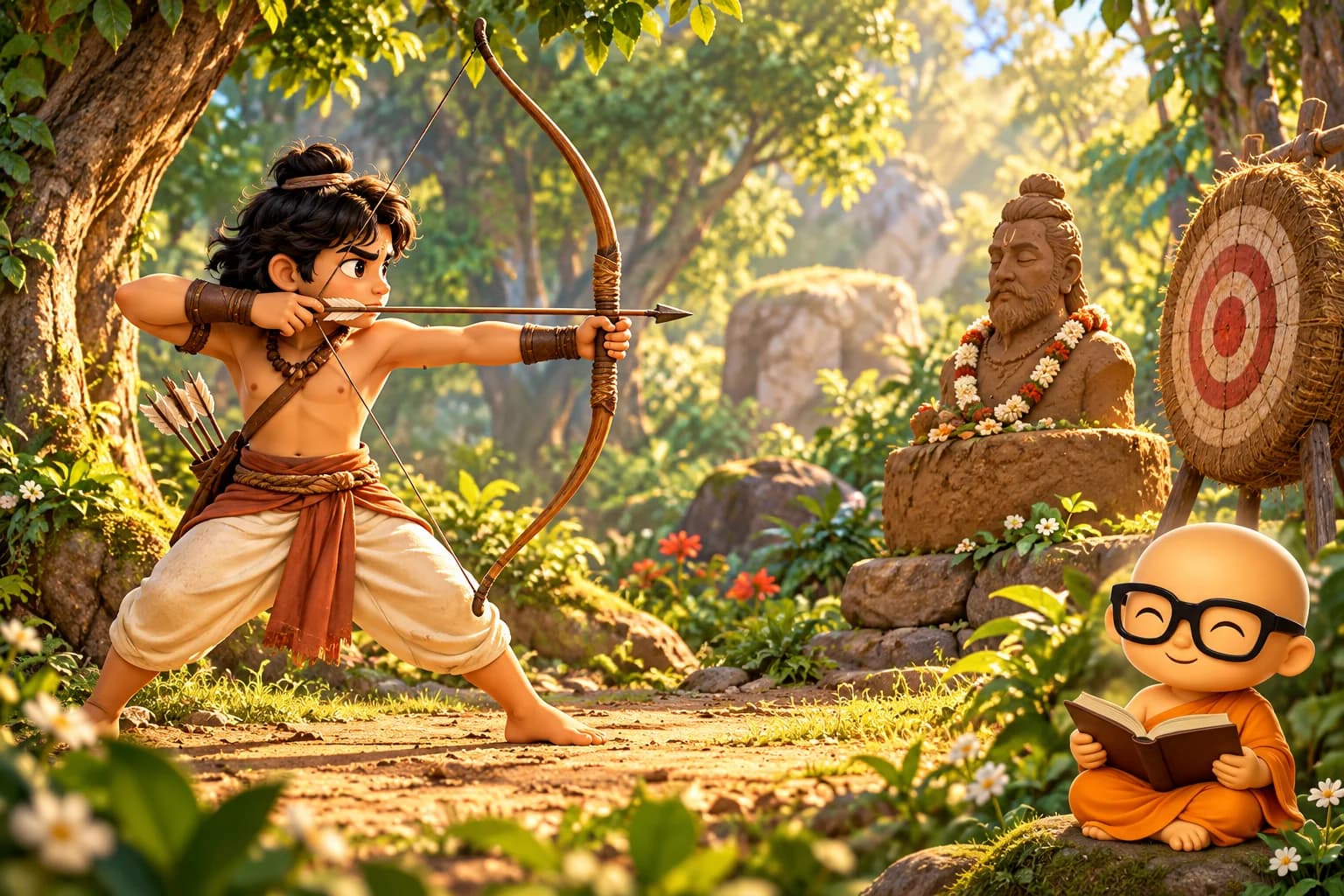
Ekalavya, a Nishada prince, wanted to study archery under Drona, the celebrated teacher of the Kuru princes. Drona refused to accept him. The epic gives no long explanation that makes this refusal easy to defend; it shows a talented young man being kept outside formal instruction. Ekalavya returned to the forest, made an image of Drona from earth, and practised before it with patience and exacting focus.
One day the Kuru princes were hunting with Drona when their dog barked at an archer. The dog soon fell silent: arrows had filled its open mouth so precisely that it was unable to bark, yet it was not wounded. The princes searched and found Ekalavya. Asked who had taught him, he named Drona and described himself as the teacher’s pupil. Drona knew he had never instructed the youth. The scene makes Ekalavya’s self-directed achievement undeniable, while also exposing how the title of “disciple” can be claimed by devotion even when a teacher has refused the relationship.
Drona had promised Arjuna that no archer would surpass him. He asked Ekalavya for guru-dakṣiṇā. Ekalavya gladly offered whatever the teacher requested. Drona asked for the youth’s right thumb. Ekalavya cut it off and placed it in Drona’s hands. The epic says he later continued to shoot, now with diminished skill. The moment is not a simple triumph of loyalty: the cost falls on the excluded student and protects the standing of a favoured one.
Ekalavya’s discipline deserves admiration; the demand deserves scrutiny. Read together, the two truths make this one of the Mahābhārata’s hardest stories about education, authority, consent, and fairness.
The exchange also changes how we should use the word “guru-dakṣiṇā.” In the epic, a gift to a teacher is offered by the student, but Ekalavya’s thumb is demanded by the authority who had already denied him instruction. His ready consent takes place inside a steep imbalance: Drona is the royal teacher, and Ekalavya is a young outsider who has named Drona as his own guru. The story leaves that tension visible. Admiring his discipline need not mean treating the demand as a model for teachers or students.
Understanding the story
The epic honours Ekalavya’s focus without making Drona’s demand fair. A reading that praises only sacrifice can erase the teacher’s earlier refusal and the cost imposed on a student he excluded.
In everyday life
Practise diligently, but question systems that deny access and then punish people for succeeding without them. Respect for mentors should include boundaries, consent, and reciprocal responsibility.
In today’s world
The story remains relevant to unequal schooling, gatekeeping, and talent overlooked because of background. Institutions should widen access and assess achievement fairly rather than protect the position of favourites.
Traditional source
Mahābhārata, Ādi Parva, the Drona–Ekalavya episode in the Sambhava sub-parvan. Chapter numbering differs by edition; the episode is a more stable reference.
Topics: Ethics · Discipline · Ekalavya · Mahabharata · Education
← All stories